AI Agents
From Chatbots to Autonomous AI Agents: Which Tasks New Models Can Already Perform on Their Own and What Developers Are Planning
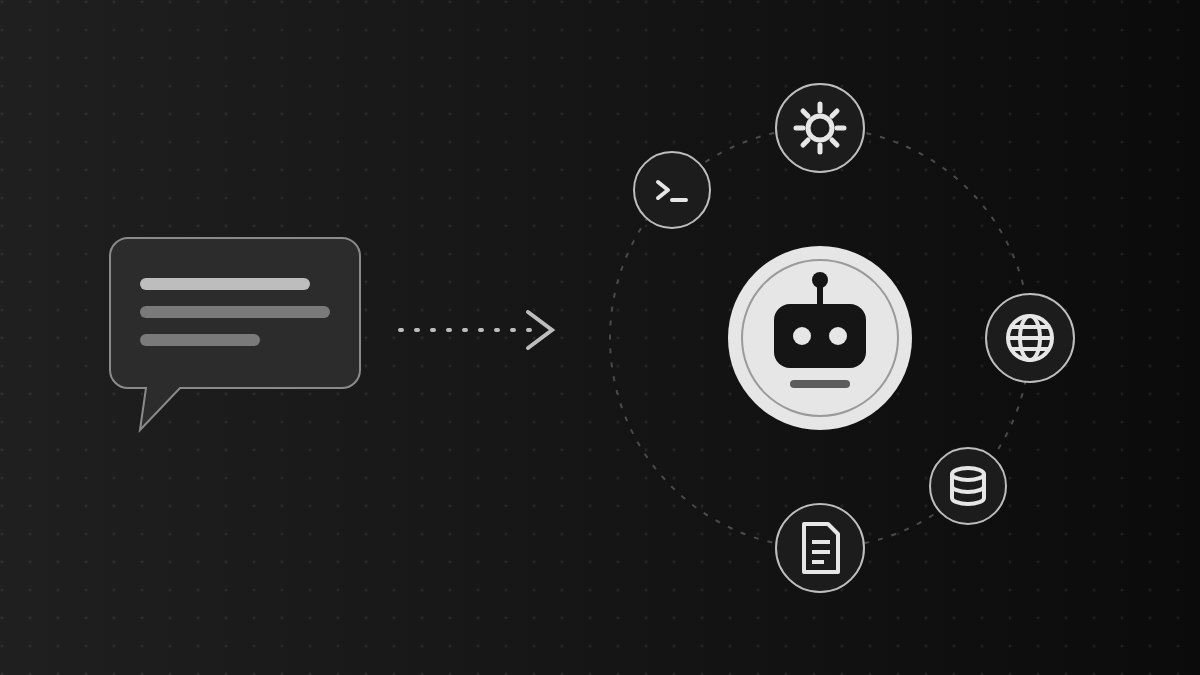
A chatbot answers a question. An agent receives a goal and decides for itself which steps to take to reach it: it finds information, runs programs, works with corporate systems, checks the result and fixes mistakes. This shift — from conversation to action — is what defines the development of artificial intelligence today and how companies assess its value.
Key takeaways
- An agent differs from a chatbot in its ability to plan, use tools and act over multiple steps;
- The most mature area for agents is software development;
- Agents already perform research, analytical and operational tasks;
- The main limitations are reliability on long tasks, security and cost control;
- Developers are betting on longer autonomy, connection standards and agents working together.
How an agent differs from a chatbot
An agent has four key properties. It plans — breaking a task into stages. It uses tools — search, databases, code, a browser, corporate system APIs. It keeps context — remembering what has already been done and what results were obtained. And it checks itself — comparing the outcome with the goal and, if necessary, going back a step.
What agents can already do on their own
Programming
This is the most advanced area. Agents read a codebase, find and fix bugs, write tests, implement small features and prepare changes for a developer to review. Humans increasingly act as the ones who set tasks and review results rather than write every line.
Research and analytics
An agent can study dozens of sources, compare data, run calculations and prepare a structured report with references. What used to take an analyst several days becomes a task of hours, followed by review.
Operational processes
Processing requests, reconciling invoices, filling in CRM records, preparing commercial proposals — agents carry out such chains of actions across several systems, turning to a human only in disputed cases.
Working with interfaces
Models have learned to operate a browser and applications the way a person does: seeing the screen, clicking buttons, filling in forms. This opens up automation even for legacy systems without APIs, although the speed and reliability of such scenarios are still lower.
Where the limits are
- Compounding errors. The longer the chain of steps, the higher the chance that a small mistake at the start leads to a wrong result at the end.
- Security. An agent with access to email, documents and payment systems becomes a target for attacks, for example through malicious instructions injected into the data it processes.
- Cost. Multi-step tasks require many calls to the model, so without limits spending is hard to predict.
- Accountability. Decisions with legal and financial consequences must still be approved by a human.
What developers are planning
Leading labs are pursuing several directions at once. The first is long-running autonomy: agents should work reliably for hours and days on a single task. The second is connection standards: protocols such as the Model Context Protocol (MCP) and Agent2Agent (A2A) make it easier to connect agents to tools and to each other. The third is multi-agent systems, in which several specialized agents divide the work among themselves. The fourth is memory and personalization, which allow an agent to take into account past experience working within a particular company.
How to deploy agents today
- Start with tasks where a mistake is easy to spot and fix.
- Give the agent only the minimum access rights it needs.
- Keep a human in the loop for key decisions.
- Log all of the agent's actions and review the log regularly.
- Measure results with business metrics: completion time, quality, cost per task.
Bottom line
Agents turn AI from a conversation partner into a doer. The technology is already delivering value in development, analytics and operations, but it requires a well-designed architecture of access and control. Companies that put such rules in place today will be able to expand agent autonomy faster and more safely as their capabilities grow.
Prepared by the editorial team. This material is for informational purposes only.